
When planning a trip to Buenos Aires, you will probably come across the word milonga while looking for tango activities. The term can refer to a musical genre or to a gathering where people dance. Understanding that difference helps you choose an experience and know what to expect when you arrive.
Questions about the meaning of milonga often arise during a first encounter with tango.. A milonga is more than the address of a dance venue. In its social sense, it is a gathering built around music, participation and customs that vary between communities. Knowing the context makes the visit easier to plan.
What does milonga mean
As a musical term, milonga refers to a genre from the Río de la Plata region that is related to tango but has its own characteristics. It can be performed in different ways, and the two names should not be treated as synonyms. For a first introduction, think of them as related musical forms within a shared tradition.
As a social event, a milonga is a gathering where people dance tango, tango waltz and milonga.These events may take place in a dance hall, club or cultural centre. The activity defines the gathering, so one venue can host different events on different days of the week.
How a tango milonga is organized
At many milongas, music is arranged in tandas, groups of tracks that allow dancers to share a sequence with the same partner. A cortina, or musical break, may separate those groups and signal a change. The exact arrangement depends on the person selecting the music and the character of the event.
Tango social dance takes place on a shared floor. Participants need to pay attention to other couples and adapt their movements to the available space. That shared setting gives a milonga a different rhythm from a performance designed for an audience and a stage.
The atmosphere also varies between gatherings. Some cater mainly to experienced dancers, while others offer a class beforehand or activities for newcomers. Before choosing an event, read its description and ask whether visitors who prefer to watch are welcome.
Social customs at a milonga
People attending a milonga share both the floor and the music. Looking after that space, respecting other people’s choices and paying attention to the surroundings are part of the experience. There is no single set of customs that applies in exactly the same way at every venue.
At some events, dancers use the cabeceo, an invitation made through eye contact and a small movement of the head. Elsewhere, invitations may be more direct. If you are uncertain, watching first or asking the organizer can help you understand the local approach without assuming all gatherings work alike.
An invitation must always be freely accepted. Nobody is obliged to dance, and remaining seated can be a valid way to experience the evening. For a visitor, a considerate attitude is more useful than trying to imitate customs they have not yet understood. Asking a simple question is perfectly reasonable.
Milonga or tango show
At a milonga, the focus is on the people taking part. Music structures the evening and the floor is a place for participation. Some gatherings include demonstrations, but social dancing remains their central purpose.
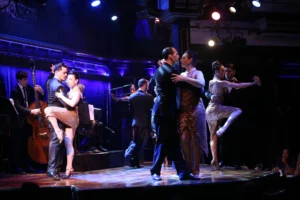
A tango show presents an artistic production to an audience. Dancers work within a staged performance, while musicians and singers may contribute to a narrative. Audience members do not need to dance or understand floor etiquette to enjoy the production.
Both experiences offer ways to encounter tango in Buenos Aires. You can choose according to your interests or include both during your stay. Look for a milonga if you want to explore the social life of the dance, and a show if you prefer to watch a performance from your table.
Choosing a milonga in Buenos Aires
Check the organizer’s programme and the city’s official tourism directory when looking for a milonga. Confirm the date, address and entry arrangements. A venue name alone does not tell you which activity will be happening on the day you visit.
If you are new to tango, ask whether a class takes place before the gathering, what level it suits and whether registration is required. If you only want to watch, check that this is possible. These questions help you choose an evening that matches your expectations.
Consider the location and your journey back to your accommodation too. Arriving with time to settle in makes it easier to observe the atmosphere. You will understand more when you can listen, notice the pauses and see how people share the space without rushing.
A first tango evening at El Querandí
If you prefer to begin as a spectator, El Querandí offers a tango show in Buenos Aires’ historic centre. You can enjoy the artistic performance without previous dance experience and encounter different periods of the genre through its staging.
A milonga offers social participation, while El Querandí offers a performance evening. Explore the available options and book through the website to choose how you would like to experience tango during your visit.