
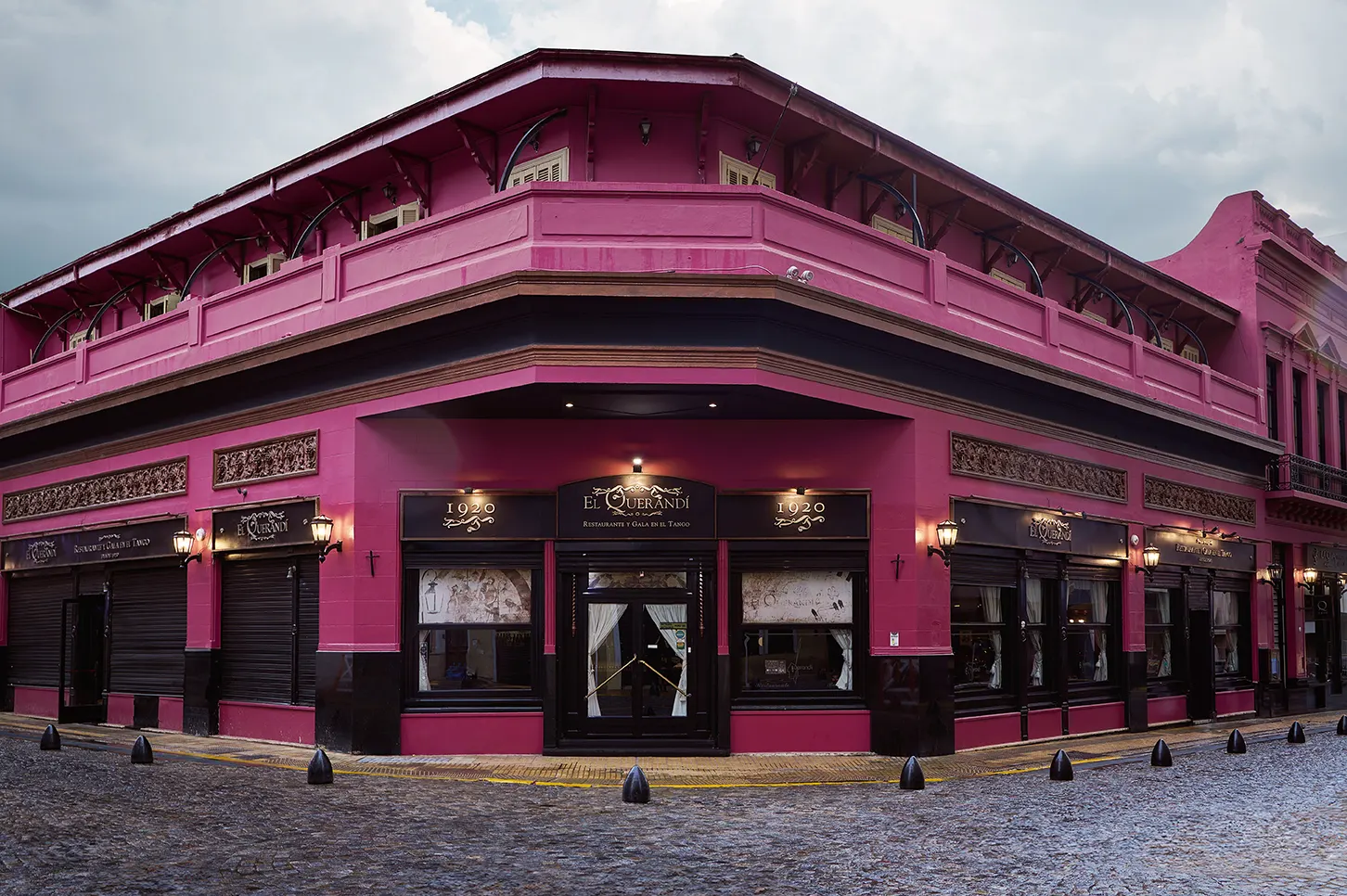
Some neighborhoods in Buenos Aires reinvent themselves every decade. San Telmo doesn’t. Its architecture, its grid of cobblestone streets, and the way it welcomes visitors have resisted time with a stubbornness that today feels like an act of identity.
San Telmo is the oldest neighborhood in Buenos Aires. It was the city’s first stable colonial settlement, home to the 19th-century Buenos Aires aristocracy until the 1871 yellow fever epidemic pushed them north. What remained — the grand old houses, the churches, the inner courtyards — eventually turned into conventillos (tenement houses) and, much later, into the densest cultural space in the city.
This guide is here to help you understand what San Telmo has that no other neighborhood in Buenos Aires does, and how to explore it without missing what matters.
The History of San Telmo: From Aristocratic Neighborhood to Tango Refuge
San Telmo’s origins as a residential area date back to the second half of the 18th century. Its streets — Defensa, Balcarce, Bolívar — connected the port to the Plaza Mayor, and the colony’s most influential families built their residences there.
The pace changed abruptly in 1871. The yellow fever epidemic killed more than 13,000 people in Buenos Aires, out of a population of 200,000. The southern neighborhoods, San Telmo included, were hit hardest. Wealthy families moved to Belgrano and Recoleta. Their houses stayed behind, and the late-century wave of European immigration moved in: Italians, Spaniards, Eastern European Jews. The grand old houses turned into conventillos, where dozens of families shared a single courtyard.
It was in that crossroads of cultures, between the arrabal (the old urban fringe) and modernity, that tango found its natural habitat. San Telmo didn’t invent tango, but it gave it a territory: the courtyards where it was danced, the corner stores where it was heard, the conventillos where African rhythms, the milonga, and the European waltz all blended together.
What to See in San Telmo: What You Can’t Miss
The San Telmo Fair and Plaza Dorrego
On Sundays, Defensa Street closes to traffic from Parque Lezama all the way to Plaza de Mayo and turns into an antiques, collectibles, crafts, and street-food fair. It’s one of the largest fairs in Latin America, running uninterrupted since the 1970s except during the most severe economic crises.
Plaza Dorrego, in the heart of the neighborhood, is the soul of the fair. Around it sit several historic bars, including Bar El Federal (founded in 1864) and Bar Británico. On Sundays, the square hosts a street milonga: tangueros improvising on the sidewalk with a speaker and a bandoneón.
The San Telmo Market
Built in 1897 by architect Juan Buschiazzo, the San Telmo Market is one of the most significant iron-and-glass structures in Buenos Aires architecture. Inside, it combines food stalls, antique dealers, and bars that open from the morning on. The central passage, with its iron columns and overhead skylight, is one of the most photographed interiors in Buenos Aires.
El Zanjón de Granados and the Colonial Tunnels
Beneath the streets of San Telmo lies a network of 17th-century tunnels and channels, discovered by accident in 1985 during a renovation. El Zanjón de Granados, at Defensa 755, is now a cultural space where visitors can tour the restored tunnels. It’s one of the few places in Buenos Aires where urban archaeology is open to the public.
San Telmo by Night: A Different Register
If by day San Telmo is a neighborhood of tourists and market vendors, by night it shifts register entirely. Defensa Street empties of stallholders and fills with locals wrapping up their workday. Bars open their doors, restaurants move into their second seating, and live music shows up on a few corners.
The neighborhood has a different scale at night. The 19th-century façades under the gas lamps create an atmosphere no other part of Buenos Aires replicates.
It’s in that context that the tango dinner show at El Querandí makes the most sense: not as an isolated tourist attraction, but as part of a night for which the neighborhood has already set the stage. El Querandí is located at Perú 302, one block from Plaza de Mayo. Walking there from Plaza Dorrego takes about eight minutes along Defensa. A night that starts with a stroll through the neighborhood and ends with a tango dinner show is one of the most complete experiences Buenos Aires has to offer.
How to Get Around San Telmo
San Telmo is best explored on foot. It has a compact block structure, and its main attractions sit within a fifteen-minute walking radius. The recommendation is to enter through Parque Lezama (on Avenida Brasil) and head north along Defensa Street up to Plaza de Mayo. That twelve-block stretch holds most of the historic neighborhood.
By subway, Line C has the San Juan station, six blocks from the market. Coming from downtown, Line A reaches Plaza de Mayo, about a five-minute walk from there. On weekends, with the volume of tourists, a taxi or car service is the more comfortable option if coming from Palermo or Puerto Madero.
The Best Time to Visit San Telmo
Sunday afternoon is peak activity: the Defensa fair is at its best, there’s a milonga in the square, and the historic bars are packed. It’s the fullest version of the neighborhood, but also the most crowded.
On weekdays, San Telmo is quieter and more authentic. Local businesses take center stage over the tourist-facing ones, and you can walk around without the pressure of the crowds. On Wednesdays and Thursdays, several bars in the neighborhood have live music without the fair-day logic.
At night, any day of the week, the neighborhood offers something the daytime can’t: the sense of being inside a city that existed long before you arrived, and that will keep existing long after.
Frequently Asked Questions About San Telmo
Is it safe to walk around San Telmo at night? The touristy areas of San Telmo — especially Defensa Street and its surroundings — are safe to walk at night with the usual precautions of any big city: don’t flash valuables, stick to well-lit, active streets. The restaurants and bars open until the small hours keep the main streets lively.
How much time do you need to see San Telmo? For a complete visit including the Sunday fair, the market, and dinner: four to six hours. A quick tour of the main spots can be done in two hours. If you add an evening with a tango show, the plan naturally stretches until 11 pm or midnight.
What to eat in San Telmo? The market has options for every budget, from empanadas and choripán to chef-driven cuisine. For a complete gastronomic experience with Argentine cuisine and a tango show, El Querandí at Perú 302 is the neighborhood’s benchmark.
Are there milongas in San Telmo? Yes. The best known is the one that springs up spontaneously in Plaza Dorrego on Sundays. For organized milongas, the neighborhood and its surroundings offer several weekly options. If you want to understand what a milonga is before going, our guide to milongas in Buenos Aires walks you through the codes and how to prepare.
Visiting San Telmo and Ending the Night with the Tango Show at El Querandí
This is more than just a conventional tourist plan — it’s the most direct way to understand why this neighborhood matters.
El Querandí was declared a Living Testimony of the City’s Memory because it has spent decades preserving tango culture in the very space where that culture grew up. It’s not a reconstruction or an attraction built for tourists. It’s the neighborhood at work.